
Published May 19, 2026
Last Updated: April 2026
A custom home in Walker County, Texas takes 9 to 14 months from the first phone call to move-in day. The actual construction runs 6 to 12 months once the slab is poured. There are seven distinct phases — site prep, foundation, framing, mechanicals rough-in, insulation and drywall, interior finishes, and final inspection — and at each phase there are specific decisions the buyer makes, specific inspections that happen, and specific things that routinely go wrong. This guide is what I wish every buyer I represent knew before we broke ground.
I’m Sean McFarlin, a licensed Texas REALTOR® (TREC 623694, Lion Drive Realty). I’ve been helping families in the Houston metro buy and sell real estate for 13+ years, and I work with buyers specifically on rural construction in Walker, Montgomery, and surrounding counties. Most of the buyers I meet have never been through a custom build. The unknown is what keeps them on the fence. This walks through the whole thing.
Why Understanding the Build Process Matters
Most buyers I meet are afraid of the build because it feels like a black box. They imagine signing a giant stack of paperwork, handing over money, and hoping a house shows up 10 months later. That’s not how it works, and the fear keeps people in apartments or older existing homes when they could be building exactly what they want on their own acre of Texas.
The reality: custom home construction is a sequence of clearly-defined phases, each with its own inspections, decisions, and visible progress. You know at every moment what’s happening. Your builder sends weekly updates. You visit the site. Draws from the construction loan happen on a schedule you can see. The loan is fixed at closing so your rate doesn’t change mid-build. And if something does go wrong, you’ve got a lender, a builder, and an agent whose job it is to get it back on track.
Knowing the process — even at a 10,000-foot level — removes the fear. It’s the difference between buyers who hesitate for two years and buyers who pick up the phone and start.
How Long Does a Custom Home Build Actually Take?
Total timeline for a Walker County custom build, first conversation to keys in hand, typically runs 9 to 14 months. Here’s how that breaks down:
Faster builds happen with production-style semi-custom builders (Tilson, K. Hovnanian) that have stock plans and streamlined crews. Full custom with upper-end finishes runs longer. Weather, labor availability, and finish changes all extend the timeline — which is why the responsible range is 9-14 months, not a precise number.
Phase 1: Site Prep — What Happens the First Month
The first visible construction step is site preparation. The builder clears the buildable envelope (where the house will actually sit — usually a 1/4 acre portion of your 1-acre lot), marks the exact house location per the approved plan, establishes the driveway path, and installs the silt fence required by the county for erosion control. If your lot needs aerobic septic (most Walker County rural lots do), the septic system is designed and a permit pulled from the Walker County Environmental Services Department.
For Deer Forest and other deed-restricted subdivisions, site prep can only begin after the Architectural Review Committee (ARC) has approved the house plans, site plan, and finish selections. That approval usually happens 2-4 weeks after you submit — so ARC approval is part of the pre-construction window, not site prep itself. Don’t let anyone start clearing until ARC approval is in writing. Starting early triggers a $500/day fine in Deer Forest, capped at $5,000.
What you do during site prep: approve the final driveway location on-site with the builder (this matters more than most buyers realize — it determines your view, your utility run, and how much tree canopy you lose). Confirm the septic system location. That’s it.
Phase 2: Foundation — Slab Poured, First Major Milestone
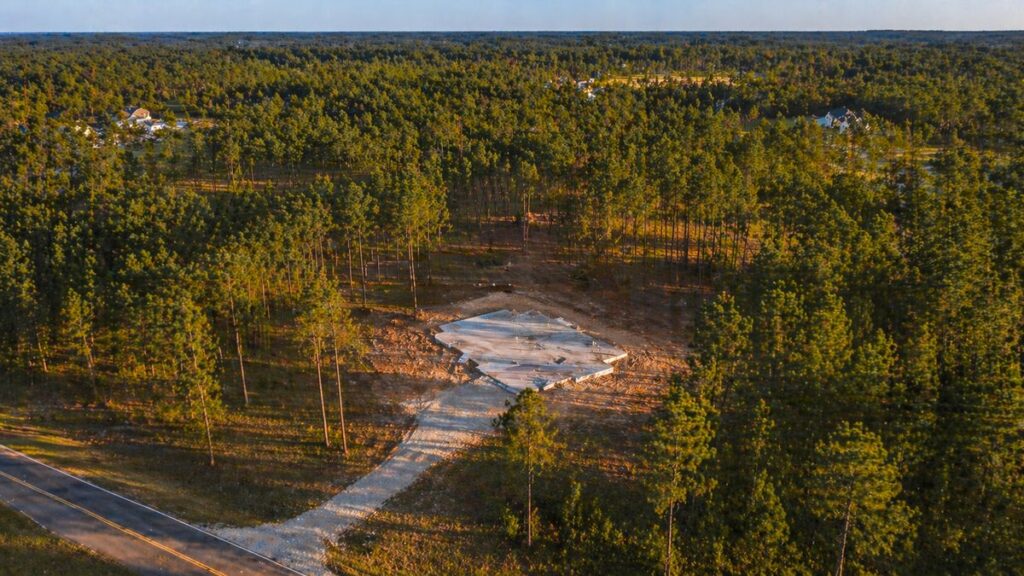
The foundation phase is short but critical. The site is excavated and leveled, plumbing and electrical stub-ups are installed per the plan, steel rebar is laid in a grid, anchor bolts are set, and concrete is poured. Most Walker County custom builds use a post-tension slab on grade — the most common foundation type in Texas because it handles the region’s expansive clay soils.
Before the concrete pour, the builder will invite you out for a pre-pour walkthrough. This is your opportunity to stand where each room will be and physically experience the floor plan at real scale. Bring a measuring tape. Imagine where your furniture goes. If a room feels smaller than you expected on paper, now is the time to say so — changes to the foundation after it’s poured are an order of magnitude more expensive than catching them pre-pour.
Inspections happen: the county inspects the forms and rebar placement, the structural engineer signs off on the foundation design, and the lender’s draw inspector confirms the work is complete so the first construction draw can be released. Once the slab cures (typically 7-10 days), the builder starts framing.
Phase 3: Framing — Your House Goes From Flat to Three-Dimensional
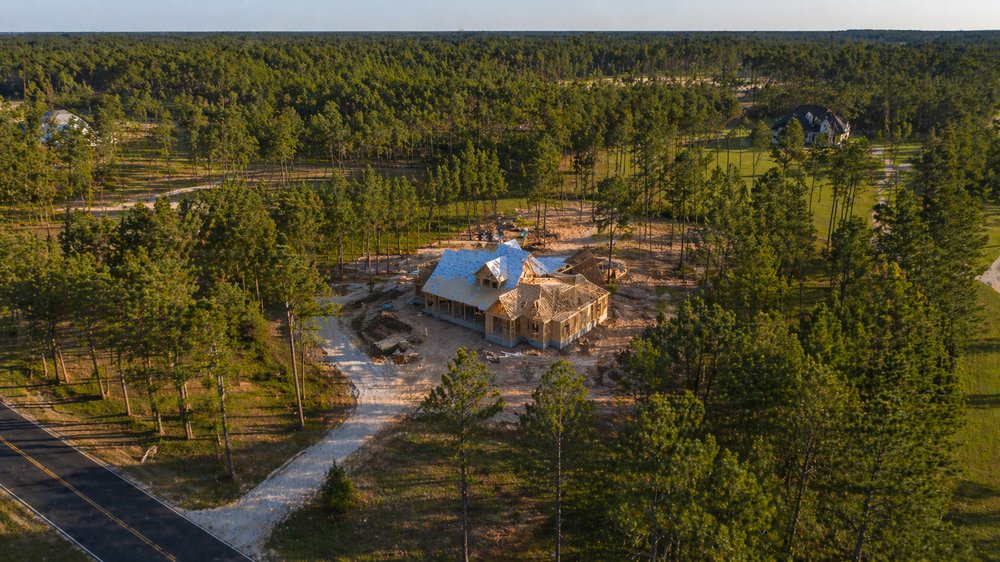
This is the phase that feels the most dramatic. Over 4-8 weeks, the house goes from a bare slab to a fully framed, roofed, dried-in structure with windows and exterior doors installed. The skeleton gets built floor by floor, exterior walls go up, interior partition walls go in, the roof is framed and decked, roofing material is installed (composition shingles or metal, per Deer Forest’s roof requirement of minimum 8:12 pitch), and windows and exterior doors are installed. “Dried in” means the structure is weather-tight — you can stand inside during a rainstorm and stay dry.
This is also when the frame walkthrough happens — the most important buyer milestone in the entire build. You walk every room with the builder, confirm the layout matches the plans, verify window placement and size, check ceiling heights, and mark any concerns with the builder’s marker directly on the studs. Anything you want to change is easiest now, before drywall goes up and hides the structure.
Once framing inspection passes (both county and structural engineer), the second construction draw releases. At this point you’re usually about 4-5 months into construction.
Phase 4: Mechanical Rough-In — What’s Behind the Walls
Phase 4 is the MEP rough-in — mechanical (HVAC), electrical, and plumbing systems get installed through the framed structure. Ductwork gets run, electrical wire is pulled and junction boxes placed, plumbing lines are installed from the slab stub-ups up through the walls, and the HVAC equipment is positioned.
This is where the houses that feel “tight” ten years from now get built right — or don’t. Good builders pull proper wire gauges, size ductwork correctly for the square footage, and install plumbing to handle future additions (like adding a water softener or a pool). Shortcut builders use minimum-spec everything and the HVAC struggles in Texas summers.
You do a pre-cover walkthrough before insulation goes in. Walk every room. Confirm every outlet is in the right place. Check that ceiling fan boxes are where you want them. Verify data/ethernet runs reach the office or media room. If something needs to move, this is the last easy time to change it — after insulation and drywall go up, moving an outlet is a $300-$500 job per outlet, not a $50 job.
Draw #3 releases after the MEP rough-in passes inspection.
Phase 5: Insulation and Drywall — The House Starts Looking Finished
Insulation goes in the walls and ceiling, then drywall is hung, taped, textured, and primed. This is a 3-5 week phase. At the end of it, your house has real interior surfaces and actually looks like a house instead of a skeleton.
Two things to know: texture matters — in Texas, the common options are “knockdown” (bumpy) or “orange peel” (lightly bumpy). If your plan specifies one and the crew does the other, that’s a rework. And: exterior siding is often installed in parallel during this phase. The house starts looking like the renderings.
Draw #4 releases. You’re typically 6-7 months into construction by now.
Phase 6: Interior Finishes — The Long Phase That Decides How It Looks
The longest single phase — 6 to 10 weeks — is interior finishes. This is everything that makes the inside feel like your home: cabinetry, countertops, flooring, tile, paint, trim, doors, hardware, light fixtures, plumbing fixtures, appliances, and built-ins.
Your finish selections were locked in during pre-construction (3-6 months ago). Those choices get installed in sequence: paint and trim first, then cabinets, then countertops, then flooring, then tile, then fixtures. If you changed your mind on something months ago and didn’t send a formal change order through the builder, now is when you find out — and changes at this stage are expensive.
This is the phase where the most “surprises” happen: a cabinet arrives damaged, the countertop slab has a flaw, a backorder on a light fixture delays the electrical crew. Good builders build 2-3 week buffers into this phase to absorb those hits. Bad builders don’t, and this is where timelines slip.
Progressive draws happen as finish milestones pass — not one big draw, usually multiple smaller ones tied to cabinet install, countertop install, flooring install.
Phase 7: Final Inspection and Certificate of Occupancy
The last 2-4 weeks of the build are the punch list + final phase. The final coat of paint goes on, appliances are installed, fixtures are set, the HVAC is commissioned, the septic system is certified, the electrical final happens, the plumbing final happens, and the builder walks the whole house looking for anything that needs touch-up.
You do the final walkthrough with the builder. Bring blue painter’s tape. Mark anything you want addressed — a scratched cabinet, a missed paint spot, a light that doesn’t work. This becomes your punch list. Reputable builders have the punch list resolved within 7-14 days of your final walkthrough.
Once the county issues the Certificate of Occupancy (CO), the lender is notified. Your construction-to-perm loan automatically converts to your permanent 30-year mortgage at the rate and terms you locked at the original closing. No second closing. No second set of fees. The loan becomes your ongoing mortgage.
And then you move in. That last month is genuinely magical. I’ve walked enough buyers through it now that it doesn’t surprise me anymore, but every buyer is surprised by how much joy is in handing them keys to a house they watched go up from a cleared lot.

Frequently Asked Questions About the Custom Home Build Process
How long does a custom home build take in Walker County?
9-14 months total from first phone call to move-in. Construction itself (from groundbreaking to CO) runs 6-12 months. Production-style semi-custom builders are faster (5-7 months). Full custom with upper-end finishes runs longer.
Do I make monthly mortgage payments during construction?
Not on your new loan. USDA and VA one-time-close construction loans roll interest-only payments into the construction budget during the build, so you don’t pay your new mortgage until the loan converts at CO. You do keep paying your current housing (rent or existing mortgage) until you move in.
What happens if the build goes over schedule?
Most lenders build a 30-60 day buffer into the construction timeline. If you go beyond that, a simple extension is usually available for a small fee. Severe delays (>6 months over) trigger a re-underwrite — the lender re-verifies your income and credit to confirm you still qualify.
Can I make changes during construction?
Yes, but changes have costs. Pre-pour changes are the cheapest — usually under $500. Frame-walkthrough changes are moderate — typically $500-$3,000. Post-drywall changes are expensive — often $2,000-$8,000 for even small moves. The cheapest change is the one you catch at the frame walkthrough.
Who inspects the house during construction?
Three separate inspectors: the county building inspector (required by law), the structural engineer (who designed the foundation), and the lender’s draw inspector (who verifies work is complete before releasing each draw). On top of that, your builder has their own quality control, and many buyers hire an independent third-party inspector for major milestones like pre-pour and pre-drywall.
What’s a “draw” and when do they happen?
A construction draw is a partial release of the construction loan funds to pay the builder for work completed. Typical schedule: Draw #1 after foundation, Draw #2 after framing and dry-in, Draw #3 after MEP rough-in, Draw #4 after drywall, Draws #5-7 during finishes. The lender’s draw inspector verifies the work is complete before funds release. Builders don’t get the full construction budget up front — they get paid in phases as work is done.
What if something goes wrong during construction?
This is what approved builders, draw inspections, and structural engineers exist to catch. Most issues get found and corrected before they become problems. Real disasters (builder abandons the project, major structural defect) are rare on approved-builder custom builds but do happen. That’s why the lender’s builder vetting, the subdivision’s approved builder list, and your own agent’s references all matter.
How much can I customize versus pick from a menu?
Depends on the builder. Production-semi-custom builders (Tilson, K. Hovnanian) have stock plans with a menu of finishes — you pick within the menu but don’t redraw the plan. Full custom builders (Partners in Building, Jamestown Estate Homes) draw to your specifications but cost more and take longer. Most Walker County buyers land somewhere in the middle: a builder’s existing plan with modest modifications plus buyer-driven finish selections.
Can I visit the site during construction?
Absolutely. I recommend weekly or bi-weekly visits during framing and finishes. Take photos. You’ll want them later. Just coordinate with your builder — some insurance policies require the buyer to sign in or be escorted on active jobsites.
Ready to Build in Walker County?
If this walkthrough clarified more than it confused, we should talk. Fifteen minutes on the phone tells us whether your situation fits a USDA, VA, or FHA construction loan, which builders on the approved list are a match for what you want to build, and what your realistic monthly payment looks like.
I have a 1-acre cul-de-sac lot in Deer Forest (New Waverly) listed at $92,500 right now — USDA-verified, VA-eligible, and ready to build on today. Details and photos are on the property page. But the broader point of this post isn’t one lot — it’s that custom rural construction isn’t as scary as it looks. The process is sequential, the decisions are clear, and your lender, builder, and agent all have skin in the game to keep it on track.
For more on the financing side, see Can You Really Build a Home With Zero Out of Pocket in Texas in 2026? and the Walker County pillar guide at Build a Home With $0 Down in Walker County, TX.
Text me at 936-283-4176 or fill out the contact form. Tell me roughly what you’re trying to build, whether you’re a veteran, and which area you’re focused on. I’ll respond the same day.
Sean McFarlin is a licensed Texas REALTOR® (TREC 623694) with Lion Drive Realty. He has spent 13+ years helping families buy and sell real estate across the Houston metro, and specializes in rural construction and acreage lots in Walker, Montgomery, and surrounding counties.
Last Updated: April 2026